FROM BISHOP BARKER — 2025 CHRISTMAS MESSAGE
Some two thousand years ago, a baby was born in a Bethlehem barn whose nativity we still celebrate every year at this time. There is much about him that we do not know: his weight in pounds and ounces, whether he arrived bald or with a shock of dark downy hair, how he slept those first few nights…all the stats that new parents record with wonder in their baby books. Even the actual date of his birth is lost to history. Still, every year at this time, the story of what took place in that barn is told around the world as Christian people celebrate the great miracle and profound theological truth about which we are certain: that in Jesus, God becomes an incarnate human being, the Creator of the universe swaddled in his mother’s arms.
It is no stretch to say that we hunger for Christmas. And surely the reason for this is that the story of Christmas reminds us of what is most essential in the Gospel of Jesus, calling us back to being the people God creates us to be, the people we long to be when we are at our best. The story of a young refugee family, fleeing persecution and struggling to make their way in the world, reminds us of our duty to the vulnerable and marginalized in our own communities. The presence of the holy in such everyday people and moments as a brave teenage mother and protective new dad, a bunch of shepherds on the nightshift, and the livestock looking on, reminds us that God still routinely breaks into our everyday, surprising us and even scandalizing us with grace and love. The story of heavenly messengers proclaiming the birth of God’s chosen one and the salvation of the world reminds us that we are saved from sin and death, and that, like the angels, we too have astonishing news to share.
Our Nebraska churches will tell this same story in different ways this week. Silence and song, candles and incense, children and elders, the hum of the city outside the door or the bright firmament of the Sandhills overhead. However we tell it, I pray we will be drawn again in faith and hope to the story of the baby born in the Bethlehem barn. May your local celebration of this great feast fill you with comfort and joy and inspire you to go share this news with the world.
Come, let us adore him!
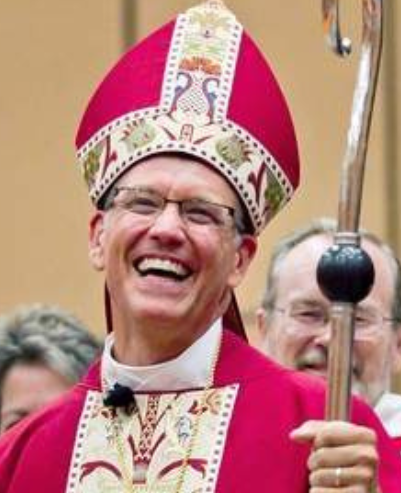
The Right Rev. J. Scott Barker
Bishop of Nebraska

A funeral service for The Rt. Rev. Joe Goodwin Burnett will be held at Trinity Cathedral in Omaha (113 N 18th Street) on Friday, January 9th, at 10:30 am. A luncheon reception will follow. The service will be livestreamed on the cathedral’s YouTube channel.
Bishop Burnett, who served as the 10th Bishop of Nebraska, entered into greater glory on November 14th at the age of 77. He is survived by his three sons and four grandchildren. More information about his life and ministry may be found here.
Visiting clergy are invited to vest and process in white stoles, gathering in the cathedral undercroft at 9:45 am. Visiting bishops, please vest in rochet and chimere with white stoles.
The Third Millennium Message, Christ Church Episcopal, Beatrice, NE
Trinity Sunday, 2025
‘Holy, Holy, Holy, Merciful and Mighty, God in Three Persons, Blessed Trinity.’ (Hymnal 1982, #362)
In the Message article for Eastertide, I closed with my own personal creed, an exercise I recommend for all who would like to be able to develop and articulate their Christian faith; so that, as the apostle Peter wrote, should the Holy Spirit lead us to share our faith and belief in Jesus with one who asks, we need not be tongue-tied but have it thought out ahead of time. Peter stated,
‘Always be prepared to give an answer to everyone who asks you to give the reason for the hope that you have (in Jesus). But do this with gentleness and respect.’
(1Peter 3:15, NIV)
What I came up with closely parallels the Apostles’ and Nicene Creeds, which are very helpful and practical summaries of biblical teachings. I just put it in my own words. I would recommend this for any Episcopalian as a good mental and spiritual discipline to take some time, ponder, pray, and then hammer it out as you ask yourself:
‘What do I do actually believe as a Christian?’ This can be categorized in different ways:
1) ‘What is truly vital to my Faith?’ (‘Essential’, the must have, non-negotiable, ‘irreducible minimum’)
2) ‘What is significant but not as important?’ (‘non-Essential’, a strong preference but not a dealbreaker)
3) ‘What might fall in-between, either way?’ (those things for which we have ‘Liberty’, can make a choice; called Adiaphora (Greek): ‘indifferent, neutral but useful’, Romans14:1)
I will be the first to admit that what I have written is not as polished or succinct as our historic Creeds. But for better or worse, it’s mine; I ‘own’ it. I suspect that it even may change over time as my understanding grows and becomes clearer. (I hope!) In fact, I have slightly modified ‘my’ creed since that newsletter article. As a (very) imperfect statement of my personal Christian faith and belief, this is expressed in several themes:
1) God as Trinity – the Father, the Son, and the Holy Spirit; Their relationships, functions, and roles;
2) Redemption, election and call; justification and salvation, sanctification and glorification;
3) the Bible, scripture, revelation, prophecy and veracity;
4) the Church, its nature and extent, ministry and authority;
5) the Sacraments, their meaning and efficacy.
I will include here only the section of my creed that pertains to God (‘theology’):
“There is a single unique Triune God, revealed in holy scripture as the Father/Originator, the Son/Jesus, Savior/Redeemer, and the Holy Spirit/Sanctifier; as Three distinct ‘Persons’ (manifestations/facets), Who are perfect, omniscient, omnipotent, omnipresent, co-equal, co-existent, co-eternal, united in Their holy Essence; Who work in full harmony and complete agreement as a single community.
a. the Full Deity of the Father, the First Person of the Trinity; being eternal Spirit; the Source, Architect, Creator, and Master Planner. The Father is the Author of Salvation.
b. the Full Deity of the Son, the Second Person of the Trinity; Incarnate from the womb of the Virgin Mary through His two distinct Natures as God and Human; Whose substitutionary death on the cross makes full Atonement for our sins; Who was bodily Resurrected from the dead, Ascended to heaven, and someday will personally Return to resurrect, judge all creatures, and recreate the world. The Son is the Executor of Salvation.
c. the Full Deity of the Holy Spirit, the Third Person of the Trinity; Whose intercessory Presence and personal indwelling are necessary for our Salvation, Sanctification, and Glorification/Completion; Who applies God’s unmerited grace and favor to us individually through our faith in Christ and His saving work; whereby we are justified, pardoned from our sins, and receive eternal life. The Holy Spirit is the Conduit of Salvation.”
We can see how the doctrine of God as Trinity is the underpinning of Christianity: how God is Self- revealed as such, how the revelation of the Trinity determines our understanding of Who God is, the ways in which God works, and the means by which an utterly transcendent God can ‘connect’ to us and we to God.
A question came to mind as I was in the process of learning about the Trinity and trying to figure it out. Although Trinitarianism is the majority view of God held among Christians, still there are appreciable numbers who do not, and either actively or passively reject the Trinity doctrine, substituting for it forms of Modalism/ Unitarianism (God is one Person), bi-theism (two gods), or tri-theism (three gods). What of them? As often the case, it depends on one’s motive. Are these beliefs simply due to ignorance, misinformation, being mis-taught? Or is it an active, deliberate intention to deceive? Whatever it is, we cannot judge another person’s salvation or standing with God. Ultimately it rests between God and the individual. But we can judge beliefs and opinions.
An answer sometimes given regarding one’s salvation, depending on an awareness of and relationship with God, is that God judges people according to the light they are given and understanding they currently have. This is what I believe.
To claim otherwise is to consign billions of people to a so-called ‘Christ-less eternity’ in hell (or some equally unpleasant state or place). That is the position of some preachers. But it is simply due to a matter of timing, if people never had an opportunity to hear or did not ‘know’ Jesus as we know Him. It all depends upon when and where they were born, circumstances completely beyond our control!
How monstrously unjust such a scenario would be if God simply condemned people to hell who never heard of Christ or were taught the wrong things about Him. It entirely repudiates the love/justice/mercy of God. It goes against everything that is revealed about God and Jesus wanting (Isa.45:22, Matt.11:28, John3:16, 1Tim.2:3-4) and seeking people to be saved! (Ezek.34:11, Luke19:10, John4:23, Rev.3:20)
(Note: By saying God wants (desires) and seeks (actively pursues through the Spirit) for all to receive salvation does not imply that all will inevitably be saved. This is Universalism. Instead of that, sooner or later, all will have an opportunity to receive it. God permits a measure of meaningful free will. We are not helpless puppets or pawns on a cosmic chessboard: God forces no one into heaven or hell. People can choose either, based on their priorities, decisions and actions they take. Not that God is ineffective, limited by our decisions. God’s will, sovereignty is not compromised; but within it, neither is our volition.)
We see a principle of progressive revelation with the Trinity. Old Testament saints (believers in God) did not have the same understanding of God in their time as did those who lived later, during the time of Christ or as do today’s Christians about the Trinity. That is not to say their view of God was ‘wrong,’ as much as it was incomplete. The Persons of the Trinity were not as explicitly revealed, say, 3,000+ years ago, as it was later developed during Jesus’ ministry on earth (with the revelation of the Three Persons at Jesus’ baptism and other occasions), and the subsequent early centuries in the life of the Church as the Fathers, bishops, pastors, theologians, and others struggled to fathom/clarify what scriptural revelation meant about the nature of God.
In those earlier years of Christianity many heresies surfaced, misguided but false teaching that resulted in considerable confusion. This prompted certain (Christian) Roman emperors, starting with Constantine, to intervene and convene the Ecumenical (Church-wide) Councils. The first was held at Nicaea in 325AD/CE. Successive Ecumenical/‘Universal’ Church Councils continued through the fourth to the eighth century .
(The number of genuinely ‘Ecumenical’ Councils is debated: how many of these should be recognized, which depended in turn upon the selective opinions and biases of those making the determination.
Some Protestants consider the first four Councils to be ‘Ecumenical’; others don’t pay any attention. ‘Oriental’ Orthodox claim there were three; Eastern Orthodox say seven, Roman Catholics recognize 21! [up to and including Vatican II, 1963-1965] The many regional councils held are not regarded as ‘universal.’)
To me, the Eastern Orthodox number of seven ‘authentic’ Ecumenical Councils is probably the most reasonable since these Councils represented the ecumenical deliberations of the Undivided Christian Church, before it officially split into Roman (Western Latin) Catholic, headed by the Pope in Rome, and the Eastern
Orthodox, headed by the Ecumenical Patriarch in Constantinople, branches in the Great Schism of 1215, when both churches mutually excommunicated each other. (the Catholics acted first) You cannot have a genuinely united and representative Church-wide Council, if a sizable part of the Church does not or cannot participate in the discussions and decision-making. If there was no organizationally united Church since the Great Schism and later compounded by the (Western) Protestant Reformation of the 1500-1700s, how could there be representative Ecumenical Councils until and unless some institutional reconciliation and reunification occurs? Good luck with that happening any time in the near future!
These first great Councils convened over the next several centuries (along with many regional synods), as efforts continued to formulate and proclaim what was orthodox, accurate, authoritative, and representative Christian teaching and practice; contrasted with what was unacceptable, heretical, and schismatic.
The results of all of these debates were many and significant: the Nicene Creed, the ‘canons’ (rules) of the early Church, the conciliar findings and declarations, not to mention the voluminous writings of those who sought to represent them. As mentioned earlier, in this sense revelation (or our understanding of it) can be considered as ‘progressive’ or unfolding, provided it does not contradict or deny that which was previously divinely revealed. God does not change His mind! (As perfect and omniscient, God doesn’t need to.)
The upshot of these centuries of deliberation, disputation, argumentation and finalization became known as ‘catholic’, ‘orthodox’, and ‘Nicene’ Christianity. Our Episcopal and Anglican Tradition shares a Trinitarian heritage with the other major branches of Christianity: Roman Catholic and Eastern Orthodox, along with the later Protestant developments of Lutheran, Reformed/Presbyterian, Ana-Baptist/Baptist, Wesleyan/Methodist and Holiness traditions, along with (some) Restoration and Pentecostal traditions, as well as many independent unaffiliated groups.
Since the above Traditions agree at least to the extent of affirming the Trinity, what keeps them apart? Why are they not one institutionally organized Visible Church that would better and more comprehensively reflect the Invisible Universal Church, that we previously have mentioned is supposed to represent?
What separated the Church into these different traditions and denominations? The reasons are many and well-documented; some are significant, others not so much:
1) historic, geographic, linguistic, ethnic, and national origins;
…
Sunday Holy Eucharist @ 10:00 A.M
The Third Millennium Message, Christ Church Episcopal, Beatrice, NE
Pentecost, 2025
‘Jesus said, “All power/authority in heaven and on earth has been given to me. Therefore, go and make disciples of all nations, baptizing them in the name of the Father and of the Son and of the Holy Spirit, and teaching them to obey everything I have commanded you.”’ (Matthew 28:18-20a)
‘Jesus ordered them (disciples) not to depart from Jerusalem but wait for the promise of the Father.. “John baptized with water, but you will be baptized with the Holy Spirit in not too many days.”…They asked, “Lord, will You at this time restore the kingdom to Israel?” He said to them, “It is not for you to know times or seasons that the Father has established by His own authority. But you will receive power when the Holy Spirit comes upon you. You will be My witnesses in Jerusalem, Judea and Samaria, to the end of the earth.”’ (then Jesus ascended to heaven) (Acts 1:4-8)
‘When the Day of Pentecost came, they were all together in one place. Suddenly there came from heaven a sound like a violent rushing wind…Divided tongues as of fire appeared and rested on each of them. And they were all filled with the Holy Spirit and began to speak in other tongues as the Spirit gave them utterance/ability…Now there were staying in Jerusalem God-fearing Jews from every nation under heaven. When they heard this sound, a crowd came together in bewilderment, because each one heard their language being spoken…Amazed, they asked, “How is it that each of us hears them…declaring the wonders of God in our own tongues?”’ (Acts 2:1-6,11-12)
Some regard the Day of Pentecost as the ‘birthday’ of the Church. It depends on ones understanding of what the Church is, its reach and extent. I prefer a broader, comprehensive perspective of the Church’s identity. ‘Church’ (Greek: ekklesia, Hebrew: qahal – ‘assembly/gathered-out ones’, not necessarily in a religious sense) While there is but One Church, it is expressed in at least two ways, and can be seen from two perspectives: the Church Invisible – in its heavenly, purified and sanctified state; and the Church Visible – being an earthly, imperfect and flawed work-in-progress that won’t become whole and perfect until Christ’s Return.
1) the Church Invisible, Universal and Triumphant – consists of all believers, from all times and places, regardless of religious affiliation, labels, or church denomination. The Church is complete as it stands: whole and includes all genuine believers. This is the ‘Bride of Christ’ of which Jesus stands as the Head. This is the ‘one, holy, catholic, and apostolic Church’ that we profess in the Ecumenical Creeds, the Apostles’ and the Nicene, which the majority of Christendom recognizes.
2) the Church Visible, Institutional and Expectant – is the human organization which had its inaugural ‘launch’ on Pentecost. It got its marching orders from Jesus at His Ascension, when He commanded them to fulfill the ‘Great Commission’: ‘Go. I have equipped you; the Holy Spirit will enable you.’ This is the Church fragmented into denominations, rival sects, and other groupings. It is made up of believers and non-believers, both ‘saints and sinners.’ It is as perfect/imperfect as those who lead and comprise it.
Linking the above three Bible passages together provided me with a somewhat different view about what ‘happened’ on Pentecost. Approximately 120 Christians had gathered together in Jerusalem, in obedience to Jesus’ instruction for them to ‘tarry’ or wait there until the Coming of the Holy Spirit. When and how would this happen? And afterward, then what? They didn’t know.
When the Holy Spirit was manifested in a tremendous theophany, appearing as tongues of flame and subsequently infilling/indwelling these disciples and apostles, they began to speak of and praise God in the multiple languages of the many Jewish pilgrims visiting in Jerusalem, who had come from all over the Roman Empire and even beyond. Why? This marked the beginning of the fulfillment of Jesus’ Great Commission:
go to all nations, preach and teach the life-giving Good News of the Gospel of Christ to those who did not know (of) Him, baptize them in the name of the Trinity, and ‘disciple’ these new, fragile, impressionable believers. Well and good. But how could they actually accomplish this mission if they could not communicate with those to whom they were sent? That language barrier still prevails today in missions and evangelism.
2,000 years ago, Jerusalem was a cosmopolitan place. As the capital of the Jewish government and headquarters of the Roman military outpost, the crossroads of converging trade routes in the Middle East and center of the majority religion in the vicinity, as well as its liturgical seat of the Temple with its sacramental worship and major festivals, it was not unusual to find many languages spoken there. Jesus Himself may have been quadra-lingual: speaking Hebrew, Aramaic, Greek and Latin. An average Jerusalemite likely was at least bilingual, especially if they were involved in trade, business, or other public affairs.
Unlike the United States today, while many languages are spoken here as well, most Americans are not even bilingual, unless in Spanish, or from Asian-speaking ethnicities, or of recent immigrant households. Otherwise, I speculate that a majority of those who are born here speak only English. In our modern society with instant communication through different media, and rapid travel (especially compared to 2,000years ago), a common language can strengthen the sense of a national bond. (Not until very recently was English declared our national language by presidential executive order, after nearly 250 years of existence as a nation.)
Knowing that the lack of a universal language outside of the Roman empire would render the command to ‘make disciples of all nations’ almost impossible to carry out, Jesus sent the Holy Spirit on Pentecost Who ‘gifted’ these disciples with the ability to share the Gospel in languages which they themselves did not know: this Gift of speaking in other ‘tongues’, human languages that were not their own. Then the linguistic barriers of Babel came down. When pilgrims in Jerusalem heard these provincial Galileans speak their own language, they could hardly believe it. Skeptics even said the disciples were drunk and spouting gibberish. But others who could understand these languages, refuted that accusation. What a difference this made in catechizing open –minded seekers for conversion! And it all was within God’s sovereign knowledge and part of the divine plan. It was the Holy Spirit’s provision for overcoming the language barrier that is still so problematic to this day.
The gift of speaking in tongues is misunderstood today, by both its critics and proponents:
1) ‘Secessionists’ make the sweeping claim that the so-called ‘Miracle Gifts of the Spirit’ (tongues and healing) are not applicable today, since they were only established for the foundational apostolic period of the Church to demonstrate its power, authority, and supernatural credibility – little more than mere ‘parlor tricks.’ Not only are these Gifts of the Spirit no longer ‘needed’ today, they are not even appropriate for our time. These folks are much bolder than me. I would not presume to limit God: to dictate what God can or cannot do! 2) ‘Continuationists’ believe that all the Gifts of the Spirit are not restricted and apply for today as well. They have been recorded in Church history in the centuries following the end of the Apostolic Age. (c.100CE) Such respected leaders and Church Fathers as Justin Martyr and Irenaeus in the 100s, Novatian in the 200s, and Augustine in the 300s – 400s all witnessed that these spiritual Gifts were still operative in their time. Additionally, no scripture specifically says otherwise: that these Gifts have, should, or need to cease. There are extremes on both ends of the spectrum. Exaggerated positions either way can be dismissed. Excessive claims or rants gain nothing. I am more sympathetic to working toward a sane accommodation.
1) Secessionists are right to be skeptical of snake-handling crazies or those who claim to raise the dead.
2) Continuationists are right in saying we cannot ‘box in’/restrict God’s power or dictate how it is used.
3) Consider the Gifts and Prophesy movements. Contrary to their positions we can definitively say that there are and no need for apostles, prophets, or any ‘new’/additional revelation today. (which does not preclude individual guidance from the Spirit of God) We refute them and say that there are:
a. no apostles today; since they as the properly laid foundation of the Church need not be re-poured.
b. no prophets today because we don’t need any. Jesus is our all-sufficient Prophet, Priest and King.
c. all revelation needed for salvation has already been given and is found within Holy Scripture.
The Gifts of the Spirit are still available because God does not change; God’s power ‘works,’ no matter when we might live. I certainly do not want to dictate to the Spirit as to when, how, and upon whom God must bestow His gifts. But people making spectacles of themselves – hysteria, throwing fits, unhinged laughing, barking, leaping about, yelling in tongues, all supposedly in the name of Jesus – are not doing it by the power of the Holy Spirit. I’m sure the devil laughs when people think that they are.
A few weeks ago I heard a well-known, influential, and respected ‘Spirit-filled’ Pentecostal preacher on the radio recount when he said to some fellow but overly-demonstrative enthusiasts that God is not deaf. We need not shout, debase ourselves or act in outlandish ways in order to get God’s attention and listen to us.
I have a very simple criterion to help determine the genuineness of claims to the Gifts of the Spirit. I’m sure you’ve heard this phrase before: ‘What would Jesus do?’ (‘WWJD’) Would Christ or His apostles act in such ways? Make spectacles of and draw attention to themselves? Behave in those extremes just mentioned? That’s a good measure we can use to discern what is appropriate and right, versus acting like a fool and being an embarrassment to the Gospel. God is not the author of confused and chaotic behavior! The Holy Spirit is sufficiently powerful/spectacular on His own, and does not need our help to demonstrate His power.
In expectation of Pentecost,
Fr. Bob+
 Christ Church Episcopal